February 10, 2011

Sweet Winter Sunshine: Marmalade Two Ways

There is something deeply satisfying about eating an orange in the dead of winter.  The juicy flesh defies the snowscape outside, and the sweet and sometimes tangy taste is an antidote to Mother Nature's heavy grey skies. 

Sure, you can buy an orange any time of the year, but now is the time to savour the fleeting season of the best of citrus fruits.  Seville oranges, with scarred and angry skin; delicate Meyer lemons, sweet and so deeply hued as to be almost orange; and my personal favourite, blood oranges, with their shockingly deep red flesh.

I wanted to capture the essence of this sunshine season in the only way we can: through preserving.  I began experimenting with preserves and canning last autumn, and was immediately hooked.  Science meets nature in an alchemy that's part art, part magic.  The best part is that you know you're participating in a practice that has changed only slightly in hundreds of years.

What better gift to give the season's citrus than honouring them in a pretty jar?  Here are two takes that will make your toast - and tummy - happy.

Blood Orange Marmalade
yields approx eight 250-ml jars

Marmalade came to its present incarnation in Scotland hundreds of years ago, but took hold more slowly in other parts of the world.  Today, orange marmalade is often part of the triumvirate of jams gracing the breakfast table.  Its combination of intense peel and jam is just the right taste to highlight a freshly toasted slice of bread slathered with butter.  But don't forget to use it as the Scots do, on everything from roast meats to desserts.

3 lbs blood oranges
Water
6 cups sugar

Note: Marmalade typically calls for 1 cup of sugar to 1 cup of liquid.  You can use this formula as a guideline for all types of marmalade.  For a fuller explantation of the science of canning, refer to my post on plum jam, which has a step-by-step tutorial on how to can.

1. Wash the oranges thoroughly, soaking in hot water if needed to remove dirt from the skin.  Trim the tops and bottoms of the oranges and score the peel in several large strips.  Remove the peel, reserving the fruit. With a serrated spoon or sharp knife, remove as much pith as possible from the peel.


2.  In a large stainless steel pot, place the peel and fill with water to cover.  Bring to a boil and continue cooking at a boil for 10 minutes.  Drain and repeat, boiling the peel for a further 10 minutes.  Drain and let cool slightly.  Cut the peel into thin strips, no more than ⅛ in thick. Set aside.

3.  With a very sharp knife, trim membrane from reserved fruit.  Remove as much membrane as possible, and cut the segments into small dice.  Place the fruit and the reserved peel in a large stainless steel pot, add 1 litre water and bring to a boil.  Boil gently for approx 30 minutes, or until peel is soft when squeezed.  Measure the marmalade; you should have about 6 cups of marmalade mixture.


4.  Return the marmalade to a large stainless steel pot, and bring to a boil.  For every cup of marmalade, add 1 cup of sugar, stirring each cupful in until it is fully incorporated.  Boil until the marmalade reaches gel stage, about 12 minutes.  Be careful not to overboil the mixture.

5.  Skim marmalade if needed, cool slightly, can and boil for 10 minutes.  Cool marmalade and store for the long winter ahead.


Lemon-Scented Orange and Ginger Marmalade
yields approx 10 250-ml jars

2 lbs Seville oranges
2 lemons
1 oz fresh ginger
3 ½ qts water
4 oz crystallised ginger, finely diced
4 ½ lb sugar

1. Wash the Seville oranges thoroughly, soaking in hot water if needed to remove dirt from the skin. Halve the oranges and lemons and squeeze the juice out. Strain the juice into a bowl, reserving the seeds.


2. Strip the flesh from the oranges and lemons, reserving, and slice the rinds into thin strips. Place the reserved seed and pulp into cheesecloth, tie with kitchen twine and set aside.

The pectin's in the pith


3. In a large stainless steel pot, combine the orange and lemon peel, the cheesecloth and the water. Bring to a boil and simmer until the peel is very soft, at least two hours.

Blood orange marmalade in front; Seville orange marmalade in the rear

4. Remove the cheesecloth bag, stir in the candied ginger and the sugar. When the sugar has dissolved, boil until the marmalade is at gel stage, about 30 minutes.

5. Take the marmalade off the heat, cool slightly, then can and simmer for 10 minutes.

January 31, 2011

Vive la France: Soupe à l’Onion Gratinée

Winter is comfort food time, and does anyone do comfort food better than the French? Hearty cassoulets, coq au vin, lamb navarin, fricassée, tarte tatin – classic bistro fare that warms the stomach and soothes the soul.

About this time of year, Richard goes to Paris on business and when he returns, he is full of stories of meals eaten and meals savoured; new favourites found and old haunts revisited. It makes me hungry for a taste of France, and nothing is more satisfying than a bubbling bowl of French onion soup, served straight from the oven.

French Onion Soup
serves 6

Here’s my take on the French classic. I like to use a mix of beef and veal stock for extra richness, and to grill the bread for an added smoky flavour.

2 tbsp unsalted butter
2 tbsp plus ¼ c olive oil
4 large cooking onions, peeled and finely chopped
2 garlic cloves, minced
1 bay leaf (preferably fresh)
2 sprigs fresh thyme
½ c Madeira
6 c beef stock (or a combination of beef and veal stock)
1 tsp fine sea salt
Freshly ground black pepper
12 slices French bread
¾ lb grated Gruyere cheese, grated
6 ovenproof French onion soup bowls

1. In a large stockpot, melt the butter in the olive oil over medium high heat. When the foam subsides, add the onion, lower heat to medium and sauté for fifteen minutes, stirring to keep the onions from sticking.

2. Add the garlic, bay leaf and thyme. Continuing sautéing and stirring until the onions are a deep golden colour. Turn heat to high, add the Madeira and cook for an additional two minutes, stirring frequently, until most of the wine has boiled off.


3. Add the beef stock, salt and pepper, bring the soup to a boil, and lower to a simmer. Cover and simmer over low heat for 30 minutes more.

4. While the soup is simmering, prepare the bread and preheat the oven to the broil setting. Brush the bread slices with olive oil and broil (or grill), turning to brown evenly. Set aside.

I love the convenience of our indoor grill for quick and easy grilling


5. When the soup has finished simmering, check and adjust the salt and pepper to taste. Place two slices of bread in each bowl, and ladle in enough soup to barely cover the bread. Sprinkle each bowl with a generous amount of Gruyere. Set the oven rack to the middle position. Place the bowls on a baking sheet, put in the oven, and broil until the cheese has melted and is bubbly and slightly brown, about 3-5 minutes.


Be generous with the cheese but not overly so; the ingredients should all play in balance with one another

6. Serve it forth piping hot for a delicious and satisfying winter dish.

January 20, 2011

Delish Dish: Kale and Goat Cheese Omelette


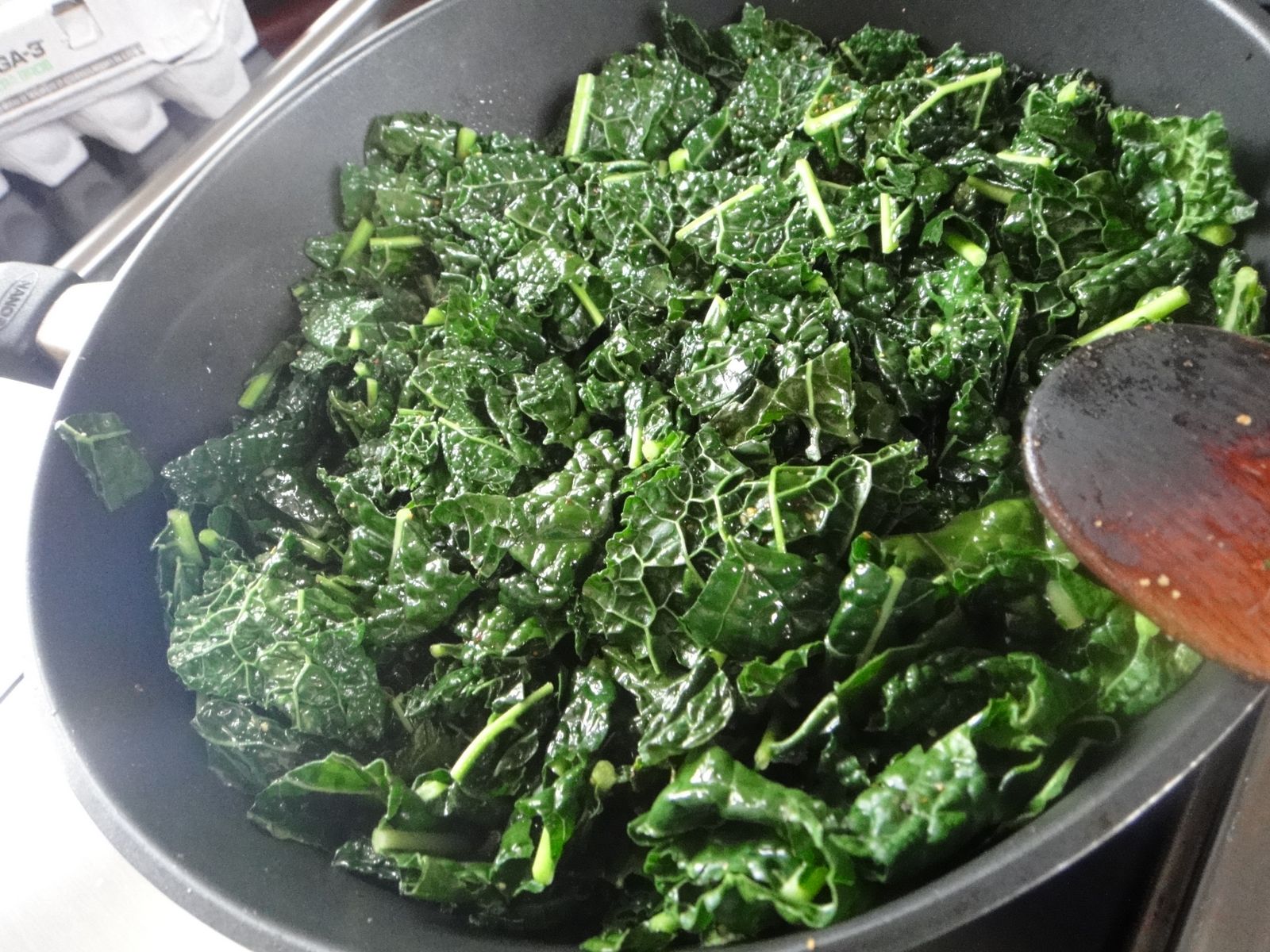
Baby, it's cold outside. The Stop's farmers’ market is near-deserted on Saturday, both vendors and customers choosing to stay home rather than battle the January storm brewing outside. I come home without the usual bulging bags, my slim pickings reflecting not just the lack of supply but the season. Cold storage Ambrosia apples from Bizjak Farms; Blossom goat cheese from Monforte Dairy; deliciously fresh eggs from Irina at Bees Universe; and my most treasured find: black kale, the famous Cavolo Nero of Tuscan cuisine, from one of the many small independent vendors the market supports.

It may not be much, but it’s the perfect combination of ingredients to make a good old fashioned hot breakfast. When the thermostat dips to way below zero, there’s nothing better than a tummy full of good food. I buy enough kale to get me through a week’s worth of warming breakfasts. Finished it off with an Ambrosia apple, it’s a most delicious winter morning feast.

Kale and Goat Cheese Omelette
serves one

Purists - please note - I am sure this is not the "correct" method for omelette making. But it works for me.  I buy kale in large quantities and prep it all at once so that it's ready in the fridge when I am.  Fresh kale can also be frozen.

2 c fresh kale, washed, trimmed and chopped into three inch lengths
4 tsp olive oil
¼ c low sodium chicken stock or water
½ tbsp Shichimi-Togarashi* (see note), or substitute a blend of taosted sesame seeds, chili pepper flakes,  black pepper and ½ tsp grated orange zest
¼ c soft goat cheese, mixed with ½ tsp grated lemon zest
2 whole eggs
2 egg whites
½ tbsp unsalted butter

1.  Prepare the kale.  In a large non-stick skillet, heat 2 tsp of the olive oil over medium-high heat.  Add the chopped kale and stir for a few minutes.  Add the chicken stock and the Shichimi-Togarashi, continuing to stir, until the kale is wilted but still has some crunch.  Remove from heat and set aside.


2.  In a small non-stick skillet, heat the remaining oil and butter over medium heat. When the butter foams, break the two eggs into the pan, and add the two egg whites.  Swirl the eggs with a fork to break up the yolk, and season to taste with salt and pepper.  Cook the eggs, lifting the edges with a spatula to distribute the eggs and cook them further.


3.  When the eggs are set but still soft, place the goat cheese in dollops over the eggs.  Add the kale, covering the entire surface of the eggs.  With a spatula, gently fold the eggs over to form an omelette.

Eggs are setting but still soft

Hard to see the goat cheese...but it's there!


4.  Cover the skillet with a lid, reduce heat to low and let cook for a couple of minutes more.

Serves one very grateful diner.


*Shichimi-Togarashi is a wonderfully complex seven spice blend that gives dishes deeply subtle nuances of flavour. It's a medium-spicy blend of seven ingredients: black sesame seeds; the dried peel of the unshu mikan (Satsuma orange); Japanese sansho pepper; dried capsicum; roasted dry capsicum; hemp seeds and poppy seeds.  Shichimi-Togarashi is available online and is worth seeking out. 

January 02, 2011

Healthy Eats: Rest-of-the-turkey Soup


I hope you saved the rest of the turkey. Maybe the bones are in your freezer, with the delicious meat carefully wrapped and stored separately. You're tired of turkey sandwiches, a turkey casserole feels like too much work, and frankly, turkey hash just doesn't sound appealing.

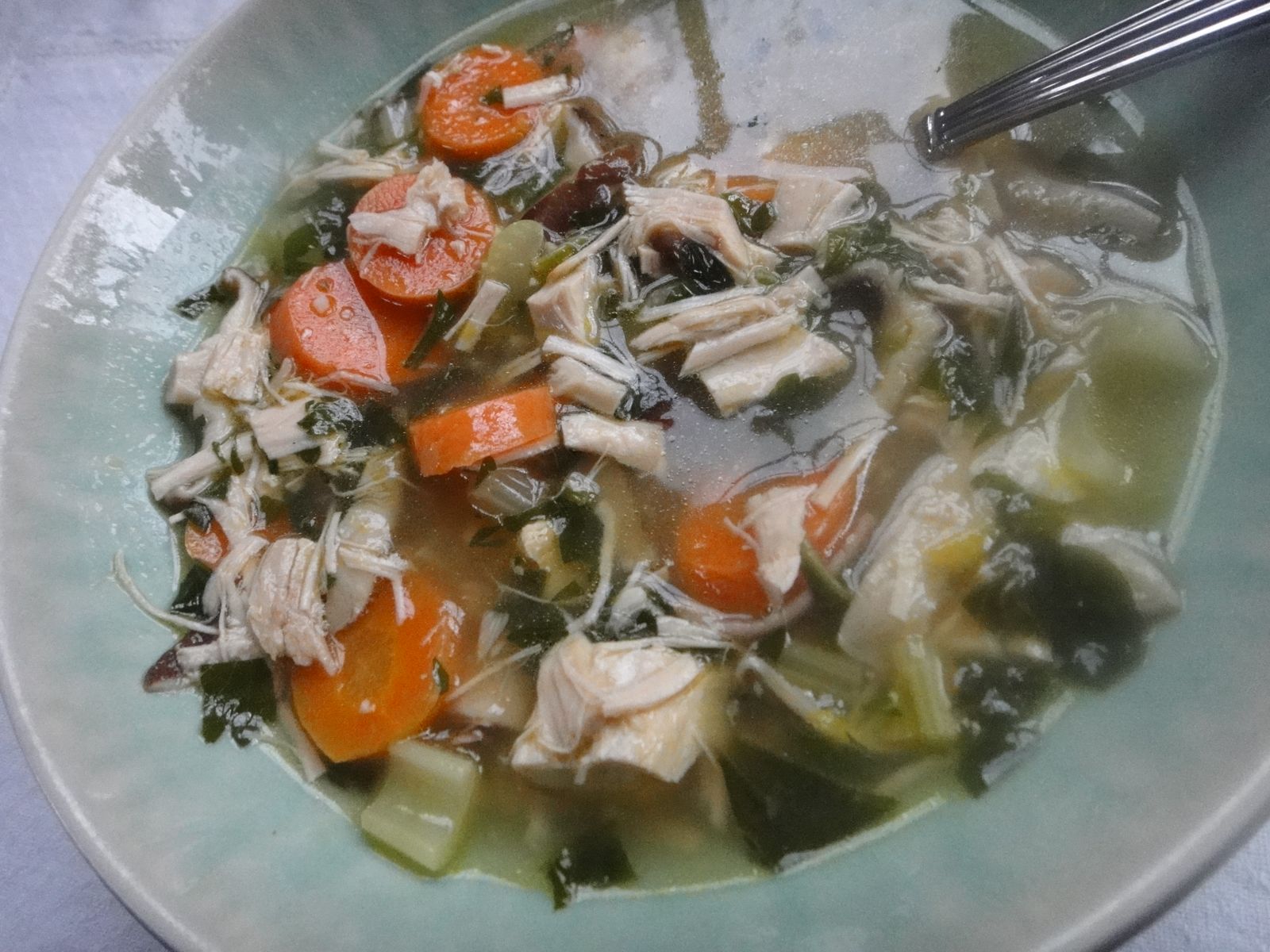
Why not make a warming and deeply satisfying soup? The perfect antidote to rich and over-indulgent holiday eating, this soup is a meal in a bowl, and also freezes well.  Richard is the soup maker in the family, and he's perfected this recipe, an old favourite of mine from Weight Watchers. He also loves eating turkey year-round, so don't wait until the holidays to make this.  Take advantage of the fresh turkey parts that are always available.

Richard's Turkey-Vegetable Soup
serves 6-8

2 c cooked turkey meat, white and dark meat combined OR one fresh turkey thigh or breast, diced*
¼ c olive oil
2¼ c thinly sliced shitake mushrooms
2 c sliced carrots
4 garlic cloves, minced
2¼ c baby spinach leaves, washed
1 c sliced celery
8 c low-sodium chicken stock (or homemade turkey stock from those bones)
¼ c parsley
Salt and pepper to taste

*If using fresh turkey meat, add the turkey in step one, along with the mushrooms, carrots and garlic, and then proceed with recipe.

1.  In a large stockpot, heat olive oil over medium-high heat.  Add mushrooms, carrots and garlic, and saute, stirring constantly, until just tender, about five minutes. 

Shitake mushrooms add a delicious flavour to this soup

2.  Add celery and spinach and cook for another two or three minutes, until spinach is just wilted.  If using cooked turkey, add at this point, stir to combine, and then add chicken stock.  Bring to a boil, turn off heat, stir in parsley, and serve.*

*If using fresh turkey, simmer the soup for an additional five to 10 minutes, or until turkey is cooked through.


December 30, 2010

Easy New Year's Eve Appetiser: Roast Beef Tortilla Roll-Ups


Delicious roast beef roll-ups

I love dishes that do double duty. That's especially true of appetisers. My favorites are the ones that can handily sub in for a quick snack or meal once the party's over.

That's why these roast beef roll ups have been an app staple at our house for years. Super easy to prep, they can be made ahead or done at the very last minute if you need more - perfect for a casual New Year's Eve gathering.  Have the fixings or a full one left over? Cut it in half and you've got a tasty wrap. Just add a salad (or potato chips if you're feeling decadent), and some pickles and you have the perfect deli-style lunch.

Roast Beef Tortilla Roll-Ups
Serves 6 as an app or two generously for lunch

¾ c cream cheese, softened
1½ tbsp extra hot horseradish
2 small tomatoes, thinly sliced
1 small red onion, thinly sliced or minced*
1 lb rare roast beef, thinly sliced
Salt and freshly ground black pepper to taste
2 10-in flour tortillas

*I usually make these with thinly sliced onions. For easier rolling, you can mince the onions and add them to the cream cheese mixture in step one.

1. In a large measuring cup, combine cream cheese and horseradish with a wooden spoon until well-blended. If using minced onions, add them and stir well to combine.

2. Spread a layer of the cream cheese mixture on a flour tortilla, right to the tortilla edge. Place roast beef slices on top of the cheese, covering slightly. Add the tomato slices and the thinly sliced onion; do not overlap the vegetables.  Sprinkle with salt and pepper.

Be sure to use the best quality roast beef


3. Roll the tortilla tightly and wrap in plastic. Refrigerate for an hour. The prepared rolls can be made up to a day in advance.*

For appetisers:
When ready to serve, slice the roll on the diagonal in 1.5 inch slices and arrange decoratively on a plate.

Perfect party bites!

For lunch:
Cut the roll in half and secure each piece with a toothpick. Garnish with your lunch fixings of choice and enjoy!

*NOTE: Refrigerating rolls allows the cheese to firm up again but you can easily make these, slice and serve. Making these more than a day in advance will result in soggy rolls - unless you eliminate the tomato.

December 22, 2010

Opening the Doors Wide: Our Annual Open House Extravanganza

Fifteen years and counting.  With the exception of 2008, when we had just finished the kitchen reno and were still covered in plaster dust and debris, every year at this time we host our annual Open House. It started in our tiny apartment with a kitchen barely the size of a closet, and an idea that it would be nice to have a few friends over to celebrate the season.    
 Apartment sized fridge to the right, where the kitchen ended; to the left a window and no more counter space.  Truly a closet sized kitchen!

Since then, it’s mushroomed into a gathering of close to a 100 people, and it gives us the perfect opportunity to cook up a storm.  Yes, we cook all of the food, served buffet style – all savoury apps, no dessert, please and thank you – ranging from house-cured gravalax to mini tourtieres; the three-cheese fondue that caused an uproar the year it didn’t appear on the table, and the always new entrees, some successful, some not.

Mini toutieres, with the best pastry dough

Carmelized tomato tatins

Cutting the rosemary-garlic infused grilled leg of lamb
 
It’s the time of year we dip into my cache of cookbooks, the back issues of Donna Hay, Bon Appetit, Gourmet and the countless other food magazines that I’ve accumulated over the years.    Do-ahead is a big factor; “able to freeze” moves a recipe high up on the consideration list.

We think we have it down to a science, and yet every year there’s that moment when panic sets in – at least for me.  Will we have enough food? Will there be a snowstorm that day?   Did we order enough plates and glasses?  And – of course – what should I wear?

Reconnections are made with friends old and dear.  We see the kids growing older, and then stop coming altogether; we witness the friendships that have been formed at our house and get renewed at this once a year gathering.  And more than once throughout the day we’re told that this is the party of the season, the one they wouldn’t miss for the world.

Tools of the trade

And while there’s no doubt that every morsel is savoured – guests know to come hungry – the one thing that is the “icing” is the party favour everyone leaves with: homemade personalised gingerbread cookies.  It’s the one bit of baking I do, and I have to say I love the smell of those cookies baking and spending the better part of a Sunday slowly rolling out dough and decorating each cookie.


Letting your cookie dough rest for an hour in the fridge makes for easier rolling

Several of the dozens of cookies made 

Having an assortment of ribbons and dragees on hand makes for easy decorating

Rolled wax paper subs in for a proper icing bag - Santa, are you listening?

Nothing more magical than seeing your own name...

 Bagged and ready for giving

Everyone has a favourite holiday cookie recipe, and not all are fans of gingerbread.  So, instead of sharing that recipe (which is a bit of a closely guarded secret) instead I’ll share my foolproof recipe for Royal Icing, which can be use to decorate not just your Christmas baking but really any cookie or sweet treat you wish.

As you bake and decorate, be sure to add a sprinkle of love on top - I guarantee you it's the one ingredient your family and friends won't be able to identify but won't be able to do without.

Royal Icing
makes 2 cups
The icing hardens as it dries, so it’s perfect for decorating cookies or baked goods that will be stored. 

2 lg egg whites, at room temperature
1 lb icing sugar, sifted, and more as needed
¼ teaspoon cream of tartar
1 tbsp lemon juice
1 tbsp water, or more as needed

1.      Combine all the ingredients in a large bowl.  Beat at high speed with a hand-held mixer until the icing is fluffy, thick and shiny, about 3 minutes.

 2.      Test the consistency of the icing by holding up the beaters.  If the icing drips off the beaters in a slow steady stream, it's the right consistency for piping.  If too thick, beat in a little water; for a stiffer icing that holds its shape, add more confectioners’ sugar.  The icing can be coloured with food colouring, which can be beaten in at this point.  Cover tightly with plastic wrap.

The icing can be refrigerated in an airtight container for up to 1 week.

December 15, 2010

Baker's Dozen: The Best Cookbooks for Holiday Giving

'Tis the season for giving, and I've been reading a lot of "Top Ten" and "Best of" lists lately.  There’s lots of advice about what to give and get this holiday season.  One list that keeps popping up in various permutations is the "Best Cookbooks of 2010" list.  Seems it's been a bumper year for great cookbooks, and everyone wants to weigh in on their personal favourites.  

I love these lists. I read them to see which books I've missed, which ones I'll give and which I hope that Santa tucks under the tree for me.  But even with stellar lists like this year's, in my mind I go back to my favourites; the tried and true workhorses of my kitchen that never fail to instruct, to surprise and to entertain.

For this Christmas, or for whatever else you may celebrate throughout the year, I'm sharing my personal list of cookbooks you should own.  While you won't find a book on baking in this baker's dozen, I'm sure you'll find something to intrigue.  There's still time to buy one or two as gifts - and be sure to tuck a new old favourite on your shelf too. 

The Best Recipe: Grilling and Barbecue, by the editors of Cook's Illustrated
This book has all the hallmarks of the Cook's Illustrated team: lots of explanation behind each technique and method; "master" recipes for dishes, with numerous variations; instructions for both gas and charcoal, plus loads of recipes for things other than meat and fish.  If you are the kind of cook that wants to know why, and you don't know Cook's Illustrated, pick up a magazine and immerse yourself in their unique blend of science and kitchen alchemy.  And then buy any one of their cookbooks.  I bought this one as a gift for Richard years ago, and the dog-eared pages are a testament to its success.

Friday Night Dinners, Bonnie Stern
The wonderful Jewish tradition of breaking bread with family is one that more of us should adopt; as Bonnie says, Friday night is a perfect time to share a meal with family and friends. I am lucky to count Bonnie as a dear friend and have been even more fortunate to eat with her and her family for many a Friday night dinner.  This is that rare instant classic: every recipe easy, relaxed and unfussy, arranged around menus that can be mixed and matched.  We make Anna's House Salad dressing by the quart, the Rack of Lamb with Harissa is divine and the Sticky Toffee Cake is just delicious.  I was thrilled that Bonnie included two of my recipes in this book too! The newest book on this list, FND was just released in paperback.

Olive Oil: From Tree to Table, Peggy Knickerbocker
A few years ago a colleague brought in a box of cookbooks that she had received from a publisher friend. Ours for the taking.  Anything to do with olive oil seemed like a good bet, and I wasn't wrong.  The front half of this book takes you on a journey of olive oil production, and everything from how to buy it to how to store it.  Many of the accompanying recipes feature different olive oil varietals, and it's fun to try and use what type's asked for (Tuscan, Greek, Spanish).  I've cooked my way through the appetisers and most of the mains, with a couple of breads thrown in too.  Simple, flavourful Mediterranean cooking, beautifully presented. 

Pork and Sons, Stéphane Reynaud
You had me at pork.  Everything to do with the glorious pig, and I mean everything. I grew up with a father who would buy a pig with a few other friends, so that they could butcher it together to make everything from sausages to head cheese (not to mention those lovely pork chops), so nose to tail eating is old hat for me.  This book is for the real pig lover.  Gorgeous photos, wonderful character pieces and - best of all - the most hilarious porcine cartoons in every chapter.  Bien sur, Stéphane Reynaud's restaurant in France is so on my list of places to visit before I die.

Soup - A Way of Life, Barbara Kafka
"Sadly, I cannot invite all of you to my house, but I think there is a full array of recipes here for happiness". So says Barbara Kafka in her lovely introduction to this book full of goodness.  Like a warm hug or toasty slippers on a cold winter's night, a beautiful bowl of soup is truly comfort food.  And, no matter what your skill level in the kitchen, soup is that most forgiving of dishes, accommodating equally scraps of leftover bits and purpose-bought ingredients.  Full of personal stories, this book is like being at Barbara's house - and what a welcoming home it is.

Cooking from an Italian Garden, Paolo Scaravelli and Jon Cohen
For a few brief years in my early 20's, I become a vegetarian, much to my parents' horror (see Pork + Sons above).  At that same time, I was slowly realising what amazing cooks my parents were, and that homemade ravioli, featherweight gnocchi and creamy lasagne were not the usual fare on most people's dinner table.  This book didn't cement my vegetarianism, but it did open my eyes to fresh, local, seasonal that is the mantra of Italian cooking, and that somehow hadn't been impressed upon me even though I lived it every day.  The dishes are rich and full of butter and oil (Ina Garten would love this book), and I still use it for great pesto, crespelle and pasta recipes, 25 years later. 

Julia's Kitchen Wisdom, Julia Child
How to choose just one Julia Child book?  I chose to put Kitchen Wisdom on the list because it's the perfect soupçon of Julia: tips. hints and the absolute best full proof recipes that showcase all of her tried and true favourites.  It's less overwhelming than Mastering but just as good at showcasing her unique voice and firm hand in the kitchen.  A wonderful stocking stuffer; or put it by your bed and dip in every now and again for inspiration.

Barefoot Contessa Back to Basics, Ina Garten
How easy is that? is the Ina mantra, and the name of her new book.  Skip that one and get this instead.  Part recipe book, part entertaining primer, this book follows the Ina formula of easy to read format, great photos, and tons of tips and simple shortcuts along with the delicious recipes.  I love the feature at the beginning of each chapter that showcases 10 easy to do things: 10 no cook appetisers; how to arrange flowers like a pro; 10 things not to serve at a dinner party, etc.  If you have someone who loves to entertain on your list, this is a must-add for their cookbook shelf.

Instant Entertaining, Donna Hay
And this is another.  I could easily add every Donna Hay book and make this list strictly Aussie (and all of her books are on my shelf).  I love that there's a photo for every recipe; I love that there are beautiful and simple ideas for imaginative table settings; I love the menu suggestions and stunning photography. I'm an avid reader of the Donna Hay magazine, and her books follow the same format, making everyone believe that entertaining with style is not only possible, it's practical.   

Bills: Breakfast, Lunch + Dinner, Bill Granger
Another favourite Aussie chef.  You can almost smell the bright clean Sydney air emanating from the pages of this cookbook.  This is especially good for family cooking, and offers up simple recipes for any time of the day.  It's worth seeking out the more exotic ingredients that may not be readily available, like passionfruit, to make the yummy desserts.  Reflecting the proximity of the water, there's lots of seafood dishes as well, and dishes with a Asian twist that are full of flavour. Yum! 

The New Basics, Julee Rosso and Sheila Lukins
Probably the most used book on my shelf.  If I were on a desert island, this would be the one I would take.  There are so many things that make it great: the comprehensive size, covering everything literally from soup to nuts; the copious sources referencing all the great cooks and their books, from Julia to James Beard and Elizabeth David; the engaging voice of the two authors.  It taught us the pleasure of making soup; how to clarify butter and has possibly the world's best apple pie recipe. A delight from cover to cover.

Madhur Jaffrey's Spice Kitchen:, Madjur Jaffrey
I got this little book 20 years ago as part of a gift set that included beautiful little tins of Indian spices, packaged in a wonderfully colourful box. Although I loved Indian food, I had never attempted to make it. Madjur Jaffrey is at once storyteller and teacher, and these recipes, meant to showcase the spices, are both simple and delicious. This book gave me the confidence to try the exotic and unknown, and taught me that spices are truly mysterious, complex and wonderful things.

Contemplation and the Art of Saladmaking, Jeanne Heiberg
This odd and wonderful book rounds out my baker's dozen.  Found in a used bookstore in Chicago, this book is part meditation guide, part story telling and ultimately about salads. Each chapter focuses on one salad recipe, sometimes with variations, with names like Vinegar of Vicussitudes Salad and Eros and Endeavor Salad. Quirky and interesting, this is another one great for bedside reading.

I hope you have a chance to buy and try some of these books. I'd love to know what some of your favourites are too!